

Dynamic interpretation of commercial vehicle policies
IntroductionThe change in this round of policies is not abou···

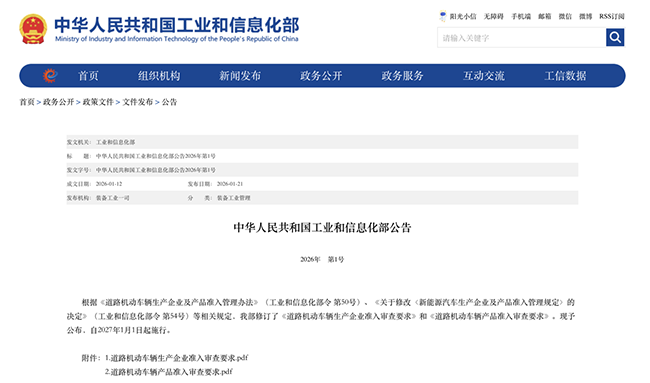
On January 21, 2026, the Ministry of Industry and Information Technology officially released the revised "Requirements for the Access Review of Road Motor Vehicle Manufacturing Enterprises" and "Requirements for the Access Review of Road Motor Vehicle Products", which are scheduled to be fully implemented from January 1, 2027. The core guidance of this policy revision is "Balancing Development and Safety". It incorporates key areas such as intelligence, networking, software online upgrades, and network and data security into the access review system, marking a comprehensive shift in the regulation of the commercial vehicle industry from traditional pre-access checks to safety capability control covering the entire product lifecycle. This sets a new compliance red line and development direction for the industry.
Policy core transformation: reshaping the development logic of the commercial vehicle industry
The impact of this new regulation on the commercial vehicle industry is systematic, with core changes focusing on three major dimensions. At the product and production levels, the policy is no longer limited to the assessment of traditional mechanical and structural indicators. Instead, it reinforces rigid requirements such as reliability testing and control of key components. Especially for new energy commercial vehicles, special operation vehicle chassis, and products with driving assistance or autonomous driving functions, higher capability thresholds have been set, requiring enterprises to possess continuous operation monitoring, hidden danger investigation, and OTA management capabilities. Facilities such as test benches and full-vehicle durability verification have become essential prerequisites for entry.
At the management standard level, the management of entrusted modifications on trucks has achieved institutionalized upgrading. The new regulations clarify that complete vehicle enterprises must bear the primary responsibility, establish an evaluation mechanism for qualified entrusted parties, sign entrustment agreements with clear rights and responsibilities, and implement full-process technical specifications and quality supervision for the modification process. This directly affects the closed-loop effect of the product certification system, consistency assurance, and recall traceability chain. Non-compliant enterprises will face the risks of failing to obtain access, being held accountable, and even facing administrative penalties.

At the level of security governance, network security, data security, and software governance have become "compulsory courses" for enterprise access. With the accelerated progress of electrification and networking of commercial vehicles, and the increasing popularity of applications such as on-board data storage, remote diagnosis, and OTA (Over-the-Air) upgrades, new regulations require enterprises to establish compliance mechanisms such as data classification and grading management, onshore storage, and offshore evaluation. They are also required to build a product operation security status monitoring platform and an emergency response system, elevating security governance from a mere IT project to the level of a core product security system.
Industrial chain reaction: Collaborative upgrading of supply chain and service chain
The implementation of new regulations has triggered a chain reaction of changes in the commercial vehicle industry chain. For original equipment manufacturers (OEMs), the traditional manufacturing logic has been disrupted. The closed-loop capabilities of research and development, production, and after-sales have become core competitiveness. The boundaries between chassis and bodywork are gradually blurring, and the trend of software-defined vehicle functions is becoming increasingly evident. The importance of service-oriented functions such as remote diagnosis, scheduling and tuning, and energy consumption management continues to rise.

At the supply chain end, key component enterprises face higher collaboration requirements. Vehicle manufacturers need to establish closer technical collaboration and quality control mechanisms with component suppliers. Offline inspection of sensors and traceability of factory data have become normalized requirements. Suppliers' participation in synchronous vehicle development and the establishment of direct after-sales capabilities have become key to enhancing competitiveness. Meanwhile, testing and third-party service institutions are facing development opportunities. They need to expand new services such as network security assessment, software and OTA testing, and reliability verification of new energy power systems, and build a service chain covering the entire access process to support enterprise compliance.
From the perspective of industry trends, commercial vehicles are transitioning from being mere "means of transportation" to "integrated hardware and software service products". The regulatory logic is focused on the systematic support capabilities of enterprises, rather than a single technological approach. This means that the core competitiveness of enterprises in the future will be reflected in their ability to continuously ensure the safety and reliability of vehicles throughout their entire lifecycle through data and services. "Selling vehicles + providing continuous services" will become the mainstream business model.
Corporate breakthrough strategy: leveraging competitive advantage through compliance construction
Facing the challenges and opportunities brought by new regulations, commercial vehicle enterprises need to build a response system from five dimensions. Firstly, they should establish or upgrade product operation safety monitoring platforms to achieve a closed loop of data collection, alarming, and disposal throughout the entire process of research and development, production, and after-sales service, laying a solid foundation for full lifecycle management. Secondly, they should improve the management system for entrusted installation of upper equipment, establish a database of qualified entrusted parties, formulate unified technical standards and on-site supervision procedures, clarify quality responsibilities and recall obligations in contracts, and ensure that the entrustment chain is compliant and controllable.

Thirdly, strengthen supply chain collaboration capabilities, accelerate the access assessment of key component and sensor suppliers, promote joint testing mechanisms, incorporate offline inspection into regular management, and enhance component quality and traceability. Fourthly, establish a full-process network and data security governance framework, strictly implement data classification and grading, onshore storage requirements, introduce third-party evaluation mechanisms, and deeply integrate Software Lifecycle Management (SLCM) into the quality management system to achieve controllable software security. Fifthly, establish long-term strategic cooperation with testing institutions and industry platforms, address shortcomings in reliability verification and functional safety testing capabilities, and provide support for regulatory compliance and product innovation.
Reshaping of upstream and downstream landscape: opportunities and challenges coexist
The new regulations not only raise the threshold for industry entry but also create new development opportunities for upstream and downstream enterprises. For vehicle manufacturers, a significant amount of resources needs to be invested in the short term to improve system construction and address deficiencies in testing capabilities, which poses certain cost pressures. However, in the long run, the enhancement of compliance capabilities will bring more stable market trust. For testing institutions, cloud service providers, cybersecurity companies, sensor manufacturers, and software service providers, the new regulations directly stimulate robust market demand, becoming an important growth point for industry development.
The competitive logic of component enterprises has also changed accordingly. By participating in synchronous development of complete vehicles, providing verifiable factory data, and establishing direct after-sales services, they can effectively enhance competitive barriers and achieve a transformation from "component suppliers" to "system solution providers". Third-party service organizations need to continuously expand their capability boundaries and help enterprises reduce compliance costs and accelerate innovation processes through professional services, becoming "boosters" for industry compliance and development.

The policy revision by the Ministry of Industry and Information Technology (MIIT) this time is essentially a systematic approach to guide the commercial vehicle industry towards upgrading towards safety, intelligence, and service-oriented development. For enterprises, the new regulations are not an additional burden, but rather an inevitable requirement for high-quality industrial development. In the short term, enterprises need to focus on system construction and addressing capability shortcomings to quickly adapt to compliance requirements. In the medium to long term, only by transforming data, software, and service capabilities into differentiated competitive advantages can they seize the initiative in the wave of industry transformation, turn regulatory requirements into market competitiveness, and achieve sustainable development.